
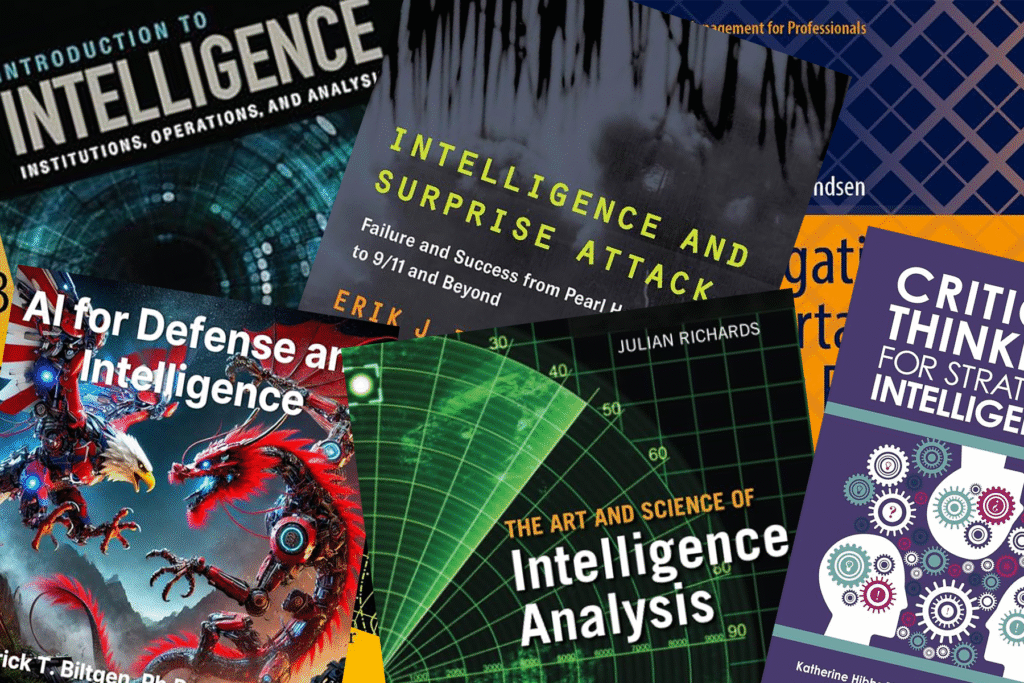
Review Essay: Books on Intelligence Analytic Methods and Techniques That Are Employed in Terrorism and Counterterrorism Studies
By Dr. Joshua Sinai
With the world of terrorism and counterterrorism impacted by latest advances in sophisticated technologies, such as in cyberspace, weaponry, logistics, software analytics, including artificial intelligence, new intelligence analytic methodologies and technologies are required to effectively analyze such trends not only in government and law enforcement counterterrorism agencies, but at the academic level, as well. Numerous books have been published on these subjects, with a representative sample of 17 books listed and briefly reviewed in this essay.
The books below are listed in alphabetical order, per the authors’ last names. This listing is followed by the books’ capsule reviewed coverage arranged by topic.
Jonathan M. Acuff, et al., Introduction to Intelligence: Institutions, Operations, and Analysis (Thousand Oaks, CA: SAGE/CQ Press, 2022), 440 pp., US $80.54 [Paperback], ISBN: 978-1-54437467-3.
Richard M. Adler, Bending the Law of Unintended Consequences: A Test-Drive Method for Critical Decision-Making in Organizations (Cham, Switzerland: Springer, 2020), 328 pp., US $79.99 [Hardcover]. US $54.99 [Paperback], ISBN: 978-3-0303-2716-3.
Patrick T. Biltgen, AI for Defense and Intelligence (Chantilly, VA: Tallaios, 2025), 379 pp., US $69.99 [Hardcover], ISBN: 979-8-2183-5148-9.
Robert M. Clark, Geospatial Intelligence: Origins and Evolution (Washington, DC: Georgetown University Press, 2020), 320 pp., US $149.95 [Hardcover], US...